
Oct . 19, 2025 13:30 Back to list
BLADES GROUP | Precision Industrial Blades & Custom OEM
Field Notes from the Cut Edge: BLADES GROUP for Meat Dicers
I spent a long morning in a processing plant in Hebei—No.311 Youyi North Street, Xinhua District, Shijiazhuang, to be exact—watching a dicer chew through chilled beef. What struck me wasn’t the machine’s speed, but the way the cutting grid stayed perfectly true. That’s the whole story with BLADES GROUP: consistent geometry equals consistent cubes. It sounds simple; in practice, it’s engineering.
Industry context: sharper, safer, simpler
Processors are shifting to tighter dice tolerances for ready-to-cook and RTE lines, and they want less downtime. Tooling has to hit food-safety standards, hold hardness, and still clean easily. Honestly, there’s no magic—just good steel, smarter heat treatment, and QA that catches drift before it hits the line.
What the product is, in plain terms
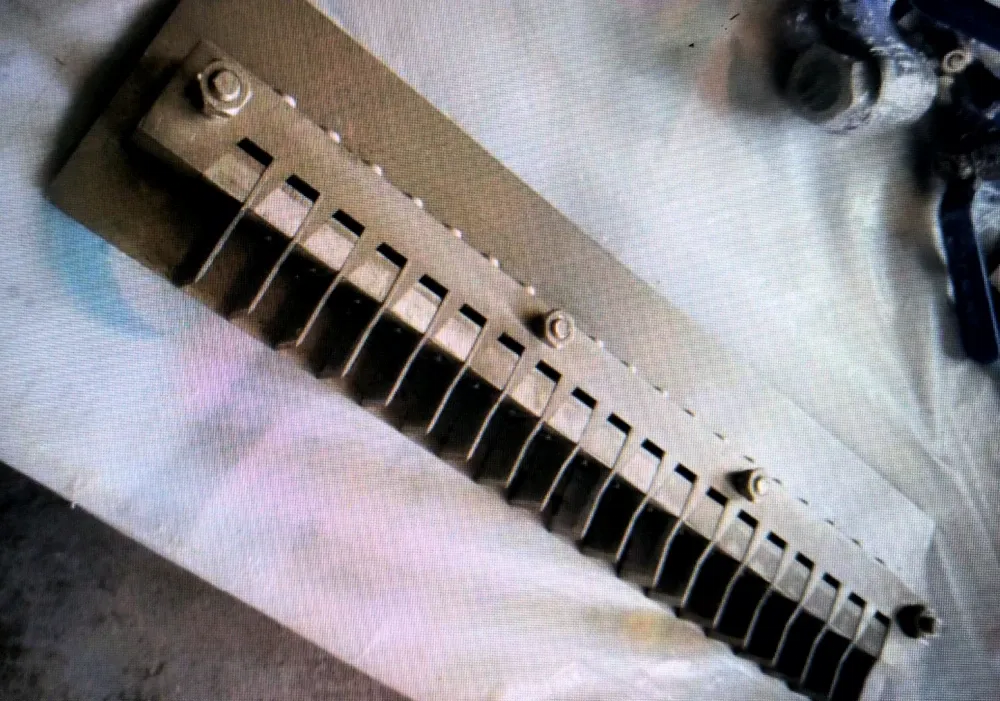
BLADES GROUP is a replaceable cutting grid for meat dicers—available in customizable sizes like 10×10, 15×15, 16×16, 20×20 mm (and others on request). It’s designed for beef, pork, poultry, and—surprisingly—semi-firm cheese and certain vegetables when spec’d correctly.
Specs that matter (real-world use may vary)
| Parameter | Typical for BLADES GROUP | Notes |
|---|---|---|
| Material | AISI 420/440C food-contact stainless (ASTM A276) | Optional 1.4116; material certs available |
| Hardness | ≈ HRC 54–58 | Per ASTM E18; balanced for chipping resistance |
| Edge finish | Ra ≤ 0.4 μm on cutting faces | ISO 4287 measurement reference |
| Grid sizes | 10×10 / 15×15 / 16×16 / 20×20 mm | Custom sizes on request |
| Dimensional tolerance | ±0.02–0.05 mm | Depends on size and blade count |
| Service life | ≈ 1–2 million cuts before regrind | Product type, cleaning, and load affect life |
How it’s made (short version)
- Materials: certified AISI 420/440C bar stock, batch-traceable.
- Methods: CNC profiling, wire EDM for slot precision, fine grinding, deburr by hand.
- Heat treatment: vacuum hardening + temper; optional cryo for stability.
- Passivation: nitric/citric per ASTM A967 for corrosion resistance.
- Testing: hardness (ASTM E18), roughness (ISO 4287), fit gauge, salt spray sampling (ASTM B117).
Applications and feedback
Used in mid-to-large meat plants, deli processors, catering kitchens, and frozen-food lines. A plant manager told me, “Dice count stayed within spec all week,” which, frankly, is what you want. Another buyer noted easier sanitation because there are fewer snag points in the frame.
Why choose it
- Consistent cube geometry reduces trim waste.
- Food-safety documentation: ISO 9001 manufacturing; materials suitable for food contact (EU 1935/2004 / FDA 21 CFR—documentation on request).
- Custom sizing—fast turnaround for odd grids.
Vendor comparison (indicative)
| Metric | BLADES GROUP | Typical Import | Local OEM |
|---|---|---|---|
| Lead time | ≈ 7–15 days | 15–30 days | 10–20 days |
| Customization | Any grid size, small MOQ | Limited, higher MOQ | Moderate |
| Tolerance control | ±0.02–0.05 mm | ±0.05–0.10 mm | ±0.03–0.08 mm |
| Docs & certs | ISO 9001, food-contact statements | Variable | Good |
Case snapshots
- Beef processor (EU): switched to 16×16 mm grid; reported ≈2% reduction in off-cuts and fewer reworks over 6 weeks.
- Poultry deli line (ME): adopted 10×10 mm; cleaning time per shift down ~12% due to smoother transitions in the frame.
Care tips (because tools deserve respect)
Avoid shock loads on frozen bricks; use staged tempering. CIP with neutral pH detergents; rinse and dry fully. Regrind lightly before dullness becomes visible—edge retention is great, but nothing beats preventive maintenance.
Standards and references
- ASTM A276: Standard Spec for Stainless Steel Bars.
- ASTM E18: Rockwell Hardness Testing of Metallic Materials.
- ISO 4287: Surface texture — Profile method terms and definitions.
- Regulation (EC) No 1935/2004: Materials intended to come into contact with food.
- FDA 21 CFR (e.g., 177): Indirect food additives—polymers and metals guidance.
- ISO 22000: Food safety management systems (plant-level framework).
Latest news
-
Comprehensive Guide to Wholesale Skip Car Solutions for Construction Efficiency
NewsMar.31,2026
-
Investing in a Wholesale Meat Salted Machine for Business Success
NewsMar.28,2026
-
Revolutionizing Burger Production with Wholesale Burger Making Forming Machine Solutions
NewsMar.26,2026
-
Comprehensive Guide to Wholesale Sausage Filler Price and Equipment Selection
NewsMar.24,2026
-
Investing in a Wholesale Beef Slicing Machine for Enhanced Business Efficiency
NewsMar.21,2026
-
Invest in a Wholesale Clipping Machine for Sausages to Optimize Production
NewsMar.19,2026